
Trace a Southlake Street Directory
Use an address as the fixed point. On the Tarrant side, the Tarrant Appraisal District property search can connect a street number to a parcel account, situs address, owner name, legal description, and linked instrument. A Denton-side parcel belongs with Denton CAD instead. That county split is a defining Southlake records issue, not a minor detail. Municipal services are citywide, but deeds, appraisal accounts, tax records, and voter records follow the county line.
The sequence below keeps ownership, registration, and historical occupancy separate. It also prevents a common error: treating a tax mailing address or a map label as proof that a person currently lives at the street address.
- Search the street number and street name in the appropriate appraisal portal. Save the account number, situs address, owner field, legal description, and instrument link.
- Open the same location in Tarrant CAID or the city map tools. Pan along the road and select only the parcels relevant to the question.
- Use the owner as a deed-index search term. In Tarrant, search the current owner as grantee, then read the prior grantor and recorded date.
- For an individual registration question, use the Tarrant voter lookup with a name plus date of birth or State Voter ID. It is not a street-browse tool.
- For earlier household clues, check regional reverse or criss-cross directories through library and archive collections, while confirming that the volume includes Southlake.
That is the practical Southlake street directory path: address to account, account to deed, and only then to narrower person or historical sources.
Southlake Parcel Cards by Address
A TAD card separates the physical parcel from correspondence details. Its sample result shows an account ID, georeference, situs address, owner or owners, Primary Owner Address, appraised value, legal description, neighborhood code, map references, tax-year documents, and a linked instrument. The primary owner address can be elsewhere. It is useful for tax correspondence, but it should not be silently substituted for the Southlake location being researched.
The TAD parcel-card result illustrates the kind of address-linked record available on the Tarrant side.
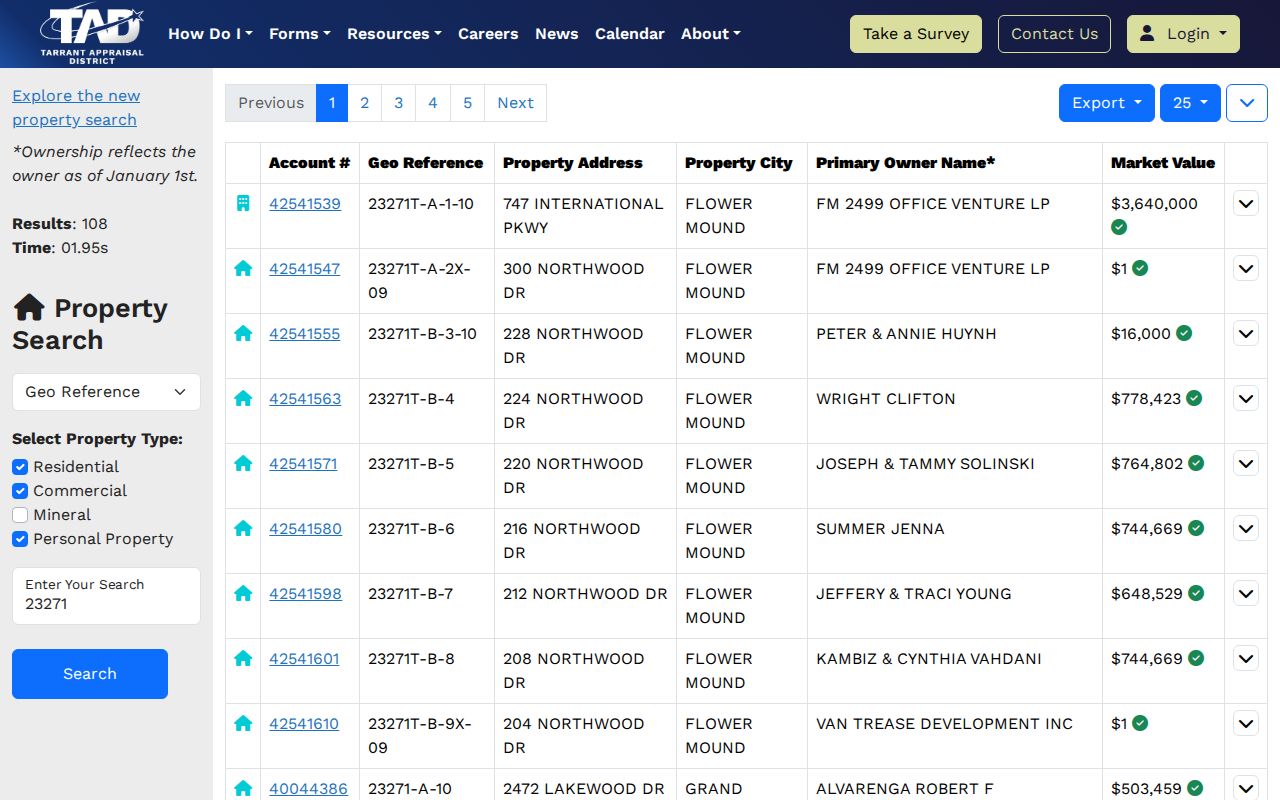
The card is an appraisal and tax record. It can identify an owner and parcel keys, but it does not publish a private household roster or establish every current occupant.
| TAD search field | How it helps a Southlake address search |
|---|---|
| Property Type | Choose Residential, Commercial, Mineral, or Personal Property before searching. |
| Enter Your Search | Use an owner, address, account, or georeference term supported by result examples. |
| Search | Returns property results for the selected property type. |
| Protest Property Type | Uses the same four property categories in the separate protest search. |
| Protest search text and From / To | Limits a protest or hearing search by term and date range. |
| Forms / Interactive Map | Links to related TAD records and map services. |
Try the normal street spelling first. If it fails, move to the account, owner name, subdivision, or legal description rather than assuming the record is absent.
Southlake Street Records by Custodian
Several public systems can be keyed to an address, although they answer different questions. The appraisal card is the starting point for parcel identity. The county clerk preserves recorded instruments. GIS adds orientation and district context. City permits may place work or review activity at an address. None of these sources alone equals a present-resident list.
| Address record | Southlake keeper | Useful fields | Access route |
|---|---|---|---|
| Appraisal parcel | TAD or Denton CAD | Account, situs, owner, mailing address, value, legal description, exemptions | Online property search; contact the appraisal office when needed |
| Tax account | Tarrant or Denton tax office | Tax-year amount, payment, delinquency context | Tarrant tax search accepts account, owner address, and owner name; Denton has its tax portal |
| Deed or plat | County Clerk | Grantor, grantee, instrument, date, legal description, lien or plat | Official index, courthouse counter, or mail request |
| Parcel map | Tarrant CAID or city GIS | Parcel polygon, roads, layers, districts, facilities | Map browse and parcel selection |
| Permit or inspection | Southlake Building Inspections | Project, review, inspection date, result, correction | EnerGov account portal or city records request |
| Code case | Southlake Code Enforcement | Address, notice, correction, department action | Division contact or Texas Public Information Act request |
A parcel account and legal description are the strongest join points. Street text can change or be omitted from an older instrument, while a subdivision, block, and lot can still connect the map to the clerk record.
Walk Southlake Streets in GIS
The Tarrant CAID GIS viewer provides Property Information Search with Main, Google, and Bing search choices, a Layer List, Facilities, and a Crime Map Portal link. Southlake’s city maps page adds zoning, ArcGIS, parks, SPIN districts, and planning context. These are useful ways to orient an address and see how a road meets parcels or district boundaries.
Start at the parcel, pan along the visible road frontage, and open individual cards when the viewer makes them selectable. A cul-de-sac, private road, county road, or parcel with more than one situs address can defeat a simple count. The CAID disclaimer also says locations may be approximate and subject to revision. Treat its polygon as a research lead, not a survey or legal boundary.
Note: GIS layers help place a Southlake street in context, but the recorded plat and deed remain the records for legal land descriptions.
Southlake Street Deed Chains
On the Tarrant side, Tarrant Official Records has Quick Search and Advanced Search. Its term field supports a grantor or grantee, subdivision, document type, or document number. Recorded-date ranges, date presets, and index-only versus full-text OCR choices help narrow a street directory trail after the owner and legal description are known. Denton-side parcels should be routed to the Denton County Clerk and its linked official-record search.
Search the current owner as grantee. The document number, recorded date, parties, and legal description point to the earlier transfer. Then search the seller as a grantee in an earlier date range. When a deed does not show a familiar street address, use the subdivision and lot-block description, the prior instrument reference, or the plat instead. The clerk provides access and search help, but does not conduct title or lien searches or guarantee a chain-of-title conclusion.
Open the Tarrant real-estate records search before ordering a document so the instrument number and parties can be copied accurately.
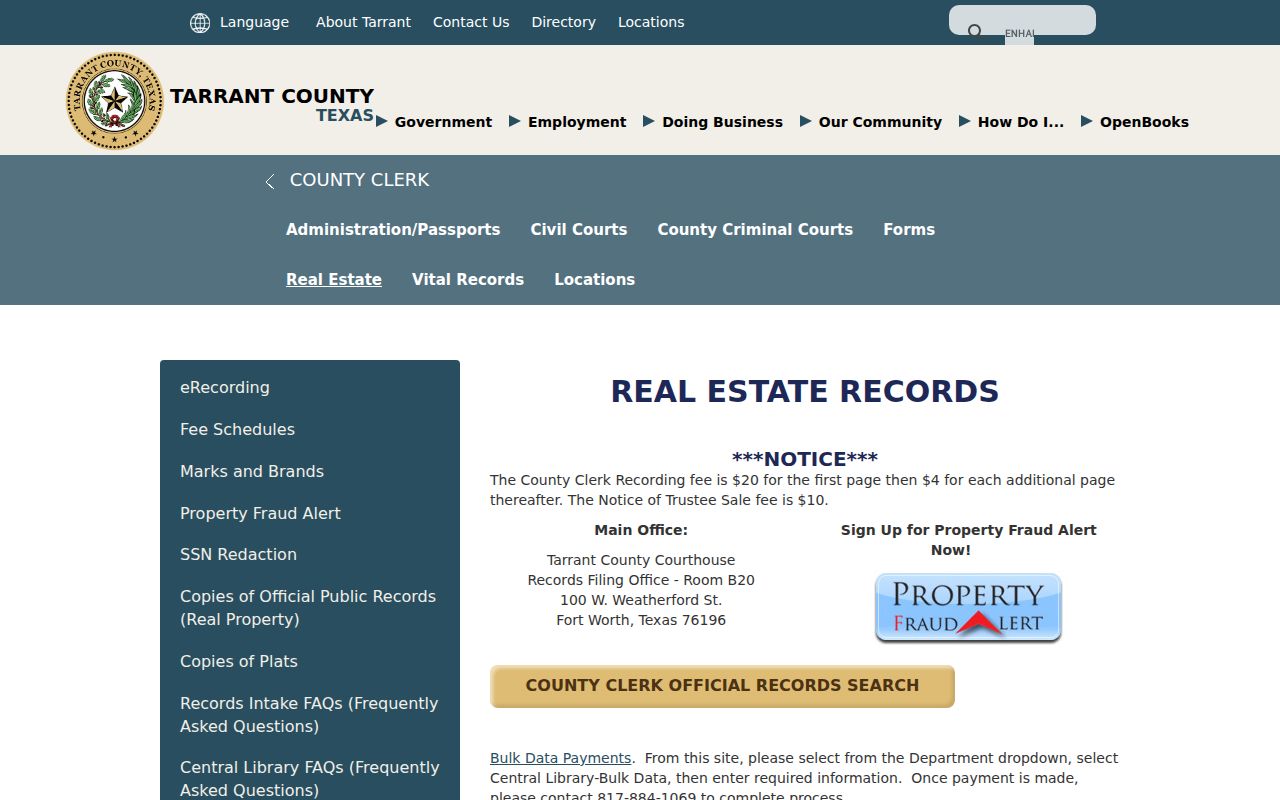
The visible controls support a targeted instrument search. They do not turn one street into a reliable list of every resident or every ownership interest.
Southlake Street Record Copies
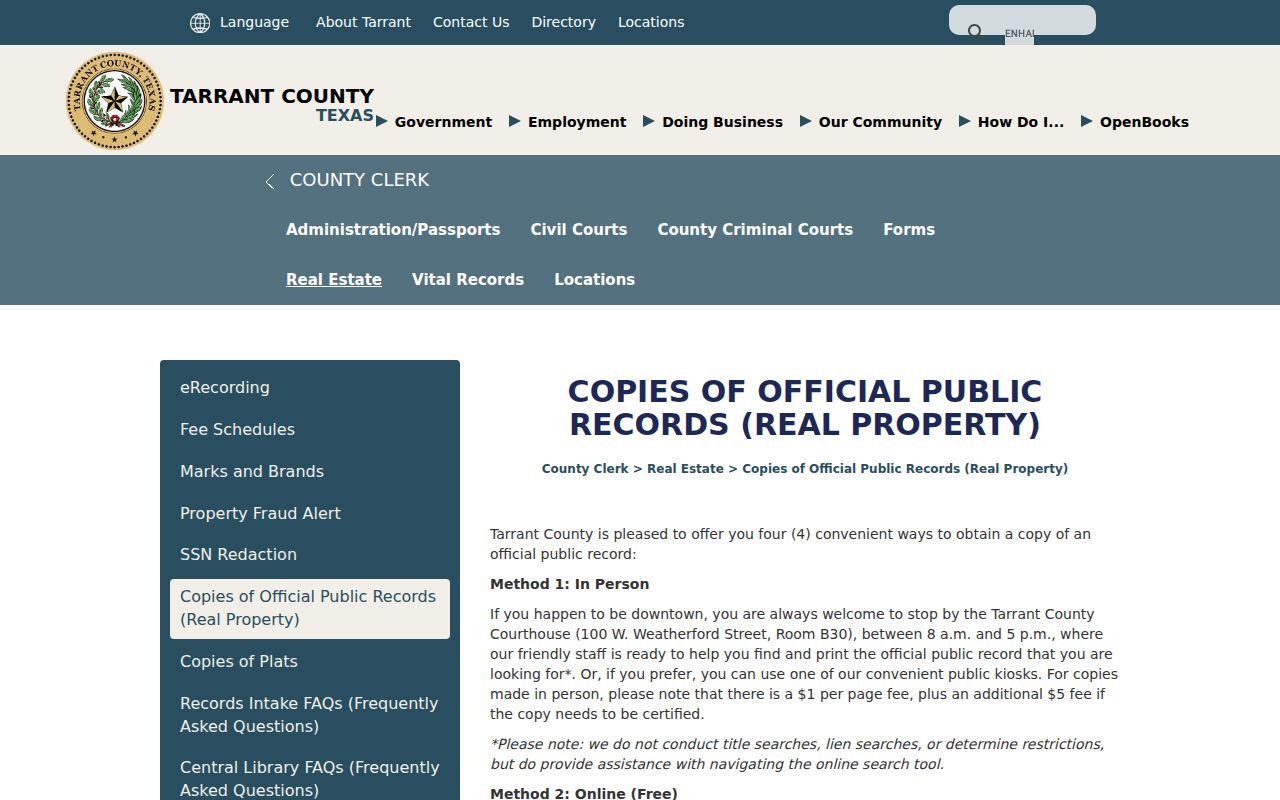
Tarrant offers more than one copy channel. Registered users can download an unofficial watermarked copy through the online system. Certified copies are ordered separately. At the courthouse, staff and kiosks are available in Room B30, 100 W. Weatherford, Fort Worth, during the clerk’s listed weekday hours of 8 a.m. to 5 p.m. A mail request needs document numbers, a self-addressed stamped envelope, and payment. The research lists Tarrant public copy charges as $1 per page plus $5 for certification.
The County Clerk copy instructions distinguish the online, in-person, certified, and mail routes.
Call 817-884-1069 for Tarrant online-search or copy assistance. Denton County has counter and mail/request routes too, but its current copy fees and live portal fields were not verified in the research, so confirm them directly with that clerk.
Southlake Permit Evidence by Address
Permit records can date construction, additions, remodels, reviews, and inspection corrections at a Southlake address. The city’s online permitting and inspections page describes electronic applications, plan uploads, project tracking, comments, approvals, inspection requests, scheduled dates, results, and corrections. These facts can help place a structure in time. They do not establish who lives there.
Open the Southlake permitting and inspections page as the first route for a current record.
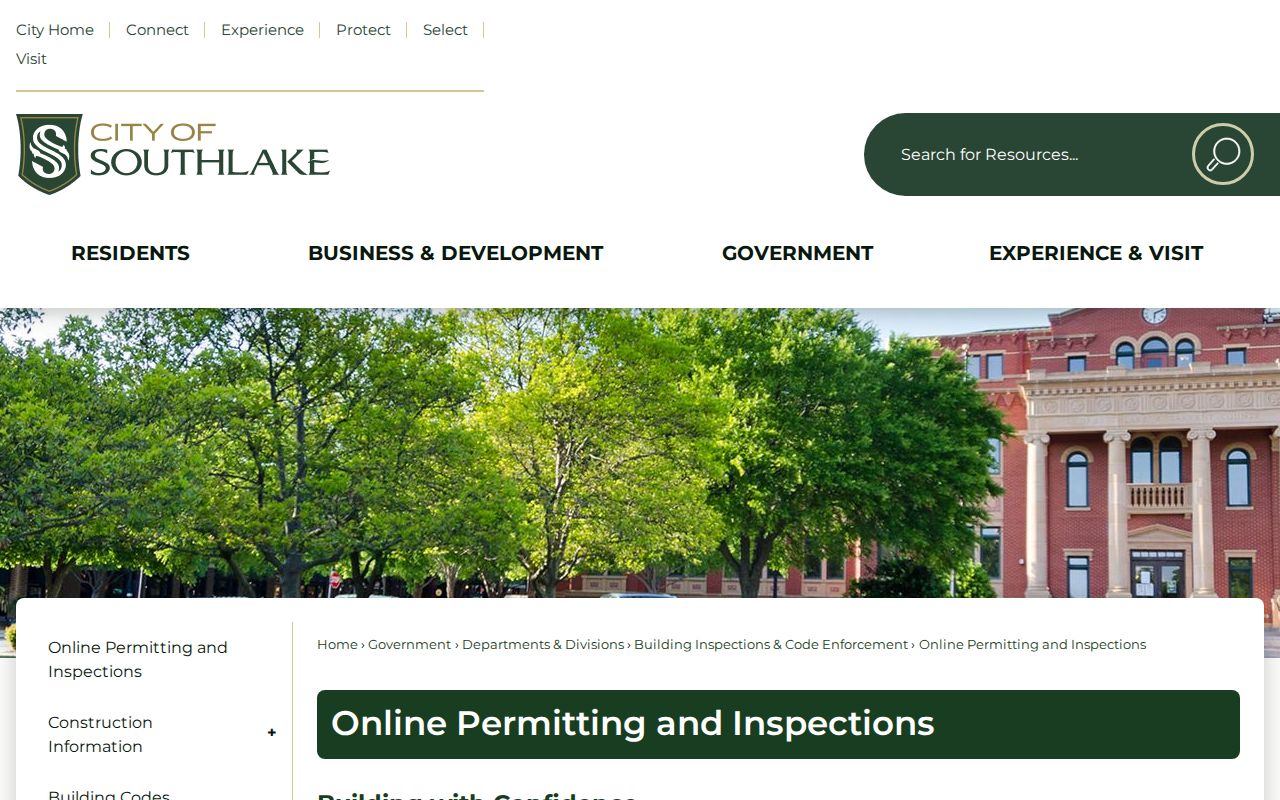
For account-linked work, the Southlake EnerGov customer self-service portal may require registration or sign-in. Its exact public field list and historical cutoff were not exposed during research.
For an older or unavailable city record, use the City Secretary’s public documents and request route under the Texas Public Information Act. A request can seek a record held by the city; it does not make private utility customer information public.
Southlake Street Directory Terms
Four short terms make address records easier to compare. They matter most when the street text changes between a tax card, a plat, and an older recorded instrument.
- Parcel
- A separately identified piece of land in an appraisal or GIS system. Its account number is a useful record key, not a guarantee of household occupancy.
- Situs address
- The physical location used by appraisal, GIS, and permit systems. It differs from the owner’s mailing or Primary Owner Address when correspondence goes elsewhere.
- Plat
- A recorded map that lays out a subdivision, block, lot, streets, or easements. It can bridge a visible street to the legal description used in a deed.
- Criss-cross directory
- A reverse-style directory arranged by address or street rather than only by name. Regional volumes may be useful, but Southlake inclusion must be checked volume by volume.
The Southlake Directory Book has the fuller historical-directory trail. Here, criss-cross material is only a supporting check after parcel and county record keys are in hand. If a street name is absent from an older index, try the subdivision name, block and lot, an owner name, a document number, and nearby lot descriptions before assuming the address has no earlier record.
Southlake Streets Before Incorporation
Older street research often begins under a different locality name. Southlake incorporated in 1956 after a rural history west of Grapevine. Older county, school, church, directory, and deed material may use Grapevine, Carroll, Old Union, Jellico, a rural route, or a road and landmark rather than the current mailing city. FM 1709 is now associated with Southlake Boulevard, and the original town lay between FM 1709 and SH 114.
There is no verified Southlake-wide street-renumbering or street-renaming list in the research. When an old number does not match, keep the legal description, nearby road, subdivision plat, and instrument number in the search notes. Tarrant records also have a real early-document warning: the Old Courthouse fire on March 29, 1876 destroyed most early documentation. Tarrant Archives and courthouse research are the fallback when an online index or book series ends.
Southlake Public Library, Tarrant Archives, and the Southlake Historical Society can be consulted for library and archive leads. Their local collections are useful supplements, not a replacement for the county clerk’s recorded instrument.
Southlake Street Directory Privacy Limits
A public street directory cannot show every person connected to a home. Tarrant’s voter lookup searches one person by last name, first name, date of birth, or State Voter ID. It does not offer a public button to browse everyone on a road. A visible registration is a snapshot of one voter’s record, not proof of every occupant. A full voter-file request can use geographic filters, but it has a fee, affidavit, and use restrictions under Texas election rules.
Nonowner occupants, guests, children, private utility and delivery customers, unlisted phones, DMV address data, sealed files, and protected voter addresses are outside the ordinary public address chain. Texas voter rules also restrict Social Security numbers, Texas driver-license or personal-ID numbers, and protected addresses. The Texas Address Confidentiality Program and protected-voter provisions can change what is displayed.
Note: Compare the owner, situs, mailing, and voter fields as separate facts because a match in one field does not prove the others.